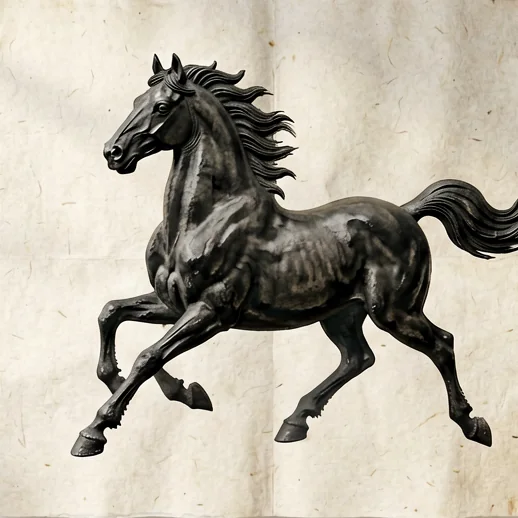
A rubbing is made by pressing paper against a carved surface and working ink into the raised parts. Everything you can read on the finished sheet follows from that one sentence. The dark areas are the carving. The light areas are the recess. The texture is the paper.
Ink density records pressure
Where a hand pressed firmly, ink sits dense and slightly glossy. Where the pressure eased, the tone thins and the paper's tooth shows through. Run a finger across a hand-pressed sheet and you can feel where the maker slowed down. A mechanically reproduced image has no such gradient: it is equally flat everywhere, because nothing was ever pressed against anything.
The variation is not a defect to be corrected. It is the record of the tool meeting the hand.
The white is the carving, not empty space
In a Tà Yin taken from a raised relief, the uninked areas are where the brick stands proud. That is why the image appears as pale forms against darker ground rather than as dark lines on white. Where the ink skipped across a ridge you get the fine streaking that printers call dry brush and rubbings simply call evidence.
Read the edges and the fibre
- The outline. A soft, slightly feathered edge means the paper was worked into the carving by hand. A hard, even edge usually means a mechanical process.
- The fibre. Long plant fibres visible in raking light are the signature of handmade paper. Uniform, invisible grain suggests a machine sheet.
- The margins. Deckle edges — irregular, slightly furry — indicate a mould-made sheet rather than a guillotined one.
- The registration of the seal. A cinnabar seal pressed by hand sits fractionally off-axis. Perfect alignment is a warning sign.
What this means when you buy
Ask for a close detail photograph, not only the full sheet. On a genuine rubbing the detail will show inconsistent ink, visible fibre and small irregularities that nobody would bother to fake. If a seller cannot supply one, you are being sold an image rather than an object.
And expect variation between two pieces pressed from the same motif. Two sheets pulled from the same carving on different days will differ in ink weight and in the way the paper took the surface. That is the honest consequence of the method — and the reason each sheet carries its own number.