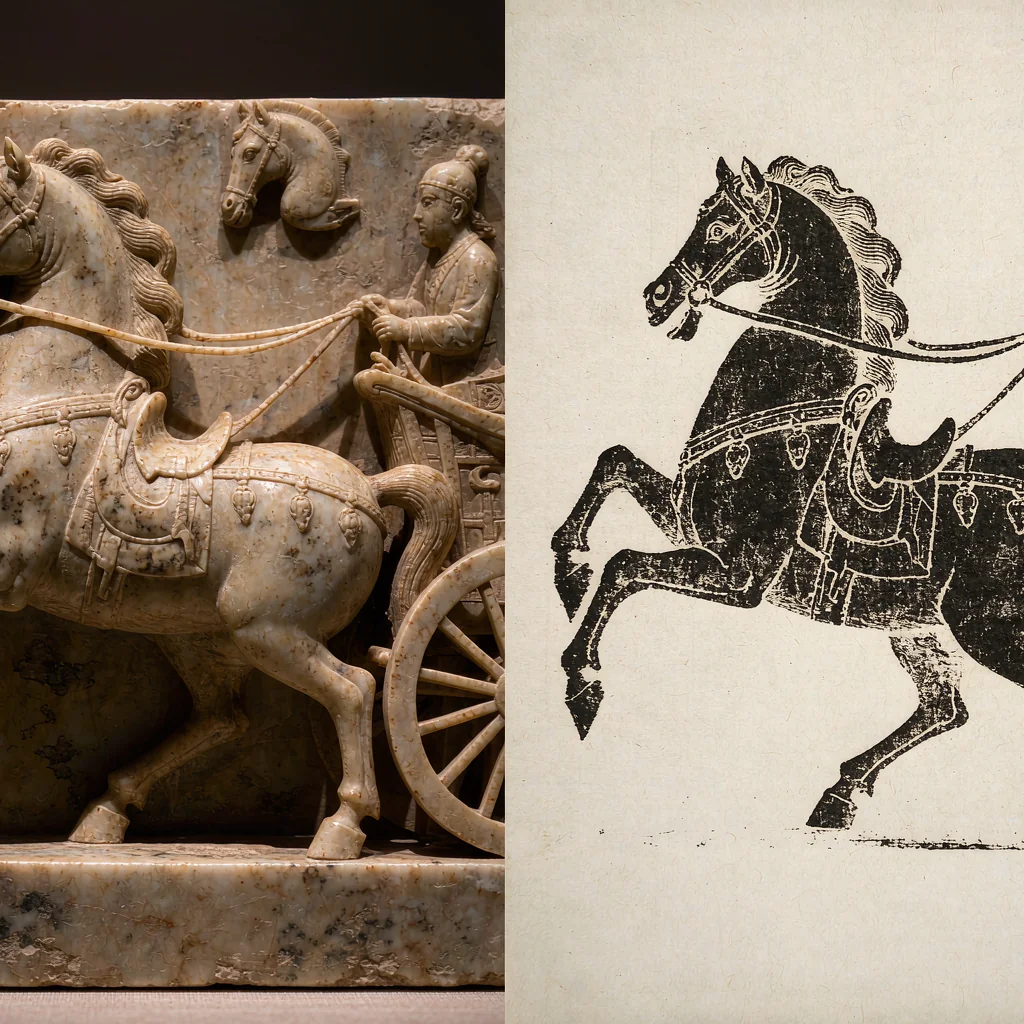
Between roughly 200 BC and AD 200, brick was a structural material across much of China. Relief carving was pressed or moulded into the faces of those bricks before firing — on the walls of tomb chambers, on offering shrines, on gate towers and on the rammed-earth walls of larger complexes.
That context matters. A horse carved into a tomb wall is not a picture of a horse. It is part of what the tomb was for.
The images had obligations
Han funerary art worked on the assumption that the dead continued to need things: company, protection, provisions, a route. The motifs on the walls were meant to supply or symbolise those needs. That is why the same images recur across centuries and across a distance of a thousand kilometres — they were not individual artistic choices so much as a shared vocabulary.
- Galloping steed
- Momentum, travel and the reach of an empire that opened the routes west. Shown mid-stride, mane lifted, almost airborne — the animal is going somewhere, and so is whoever it accompanies.
- Paired fish
- Abundance and harmony. The word for fish sounds like the word for surplus, and two fish moving in the same direction carried a wish for a household that prospers together.
- Rising phoenix
- Renewal, and the arrival of good governance. It rises rather than perches, and is usually paired with the dragon as the sovereign image of the heavens.
- Auspicious clouds
- Rolling, stylised, endlessly repeatable borders. They carried no single narrative — they were the visual language of fortune itself, wrapped around whatever they framed.
These were not decorative choices. They were a vocabulary shared by everyone who commissioned the walls.
Why press, rather than cast or copy
A cast reproduces the shape of the brick. A photograph reproduces how it looks under one particular light. A rubbing does neither: it records the physical contact between paper and the carved surface, at the scale of the carving itself. What you get is the depth of the relief translated into ink — the tool marks, the wear of two thousand years, the places where the stone has spalled.
It is also the oldest surviving technique for taking an impression of a carved surface, and it is still done the same way because nobody has improved on it.
What that means for the piece you buy
You are buying a physical record of contact with an object from the Han period, made by hand, in the traditional manner, on paper that will outlast most of what is printed today. The motif is ancient. The sheet is new. Both of those facts are the point.
What we do not claim: that your sheet is itself two thousand years old, or that the specific brick will never be pressed again for anyone else — the historic motif reliefs are working tools and are reused. What is unique to you is the seal, pressed once and destroyed on camera. We explain that in full on the seal ritual page.